DigCompAE Testing Clone
Integrating DigComp into Adult Education Holistically - This is a clone of the original site for testing purposes
  • Start
  • About this project (3)
    • Consortium
      • Member organisations
    • Project leaflet
    • News
  • Events (2)
    • Project meetings
    • Staff trainings
    • Other events
  • Project results (3)
    • Collection of good practice
    • Workshops concepts
    • Integrating DigComp - Live reports
      • Blog Austria
      • Blog Germany (EN)
      • Blog Italy
      • Blog Slovenia (test with all Ls)
      • Blog Hungary
      • Blog Sweden
      • Blog France
  • What is DigComp? (2)
    • Library
  • Start
  • About this project (3)
    • Consortium
      • Member organisations
    • Project leaflet
    • News
  • Events (2)
    • Project meetings
    • Staff trainings
    • Other events
  • Project results (3)
    • Collection of good practice
    • Workshops concepts
    • Integrating DigComp - Live reports
      • Blog Austria
      • Blog Germany (EN)
      • Blog Italy
      • Blog Slovenia (test with all Ls)
      • Blog Hungary
      • Blog Sweden
      • Blog France
  • What is DigComp? (2)
    • Library

Events

April 13, 2026 141

From Tool to Thinking: Digital Competences in Adult Education

A BarCamp event will be held in Hannover, Germany, on 24 June 2026, to open the floor for in-depth discussions of adult education experts and practitioners about the implications of digitalisation for society in general and for educational institutions in particular. The event…
  1. Aktuelle Seite:  
  2. Uncategorized

Erste Gedanken für Mitarbeiter-Fortbildung

Was uns von Angang an bewusst war: Um DigComp in unsere täglichen Arbeitsabläufe an der VHS Hannover integrieren zu können, müssen alle Mitarbeiter*innen eine klare Vorstellung haben, was DigComp eigentlich ist. Das bedeutet nicht nur, Faktenwissen dazu zu zu haben. Vielmehr sollten sie auch eine eigene Einstellung dazu entwickeln (egal ob positiv oder kritisch). So etwas kann nicht durch einen Sachvortrag erreicht werden. Es erfordert aktive Auseinandersetzung jedes einzelnen mit dem Thema. Als Erwachsenenbildner wissen wir, dass die besten und nachhaltigsten Lernergebnisse erzielt werden, wenn das Lernen in einer Gruppe stattfindet und wenn  Diskussionen und unterschiedliche Perspektiven einen guten Teil des Trainings bilden.

Deshalb war es von Anfang an unser Ziel, ein Workshop-Konzept für unsere Mitarbeiter zu DigComp zu entwickeln, das ihnen ermöglicht, sich durch verschiedene Formen der Interaktion mit dem gesamten komplexen DigComp-System vertraut zu machen.

Dies könnte Folgendes umfassen:

  • Einstiegs-Präsentation 
  • Sammlung von Erfahrungen mit digitalen Kompetenzen
  • Was sind digitale Kompetenzen überhaupt?
  • Ist der Begriff „digital” (im Gegensatz zu „analog”) gut gewählt? Oder führt er in die falsche Richtung?
  • Welche Erfahrungen habe ich mit den digitalen Kompetenzen unserer Kunden (Kursteilnehmenden)?
  • Ist DigComp der einzige Weg, um digitale Kompetenzen systematisch anzugehen?
  • Welche digitalen Kompetenzen sind für mich und für meine Lernenden relevant?
  • Wo im Alltag benötigen Menschen heutzutage digitale Kompetenzen?
  • Wie kann die Berücksichtigung digitaler Kompetenzen in Kursen eine Rolle spielen, die auf den ersten Blick nicht „digital” sind?

Imprint

DigCompAE is a project financed under the Erasmus+ Programme of the European Union.

Project number 2023-1-DE02-KA220-ADU-000167171


logosbeneficaireserasmusright en 0


Project coordinator is VHS Hannover, Germany.

Project consortium.

Responsible for the website:

This website is being run on behalf of the DigCompAE project by Jürgen Hosang, 19067 Leetzen, Contact: Diese E-Mail-Adresse ist vor Spambots geschützt! Zur Anzeige muss JavaScript eingeschaltet sein. 

Data protection

Data Protection on this Website

We are pleased that you are visiting our website! Protection of your personal data is an important concern for us. In this declaration we explain what information may be collected and stored during your visit to our website.

Collection and processing of personal data (such as name, address, telephone)

When you visit our website, our web server, for the purpose of system security temporarily stores the connection data of the requesting computer. This may incluce: pages you visit; the date and duration of the visit; the identification data of the used browser and operating system type; and if applicable the web page from which you came to visit us following a links.

Additional personal information such as your name, address, telephone number or E-mail are not affected unless you provide this information actively to the site e.g. by posting a comment (if the comment function is enabled), send us a message, or for sign up for a newsletter.

Use and disclosure of personal information

We use the personal data you provided (name, or email address) only to respond to your request or to register your email subscription should you register for one. We do not use this information for any other purposes. We do not use it for purposes of sales, and we do not transfer to third parties. (Exception see below for Google and Facebook.)

Security

We take all necessary protections according to legal requirements and state of the art in technology and common good practice to protect your data against loss and misuse. Data are stored in a secure environment not accessible to the public (unless possible illegal means are employed). We cannot be sure, however, to protect your data against attempts of domestic or foreign secret services to get access to data on servers. < /p >

Right to receive information

On written request we will send you information what of your data (name, e-mail-address, IP-address) is currently stored on our system.

Contact

For information with regard to the processing of your personal data you please turn the address listed in the imprint of this website. Should you see there multiple addresses, chose one. < /p>

Contact form

If you find on this website a contact form (this option might be disabled), and use it to send us a message, please be aware that also the data communicated by you in the form will be stored on our servers.

Use of cookies

This website uses cookies. Cookies are small text files that are stored on the the requesting computer in order to store certain information related to website use. Such information is typically the frequency of use; pages visited; data on user behaviour when visiting the website. This is used e.g. in order to store your language preferences so that you have a better user experience when re-visiting the page. Cookies remain stored on your computer beyond the end of a browser session and can be accessed when re-visiting the page. If you don't want that, you can set your browser to not accept cookies. (See your browser’s settings.) You also can locate the cookies (consult your brower’s manual to learn where) and delete them.

Facebook links

In case you see Facebook elements on our website (which however most probably will not be the case) then the following applies: When you visit our site, and you are also logged in to Facebook, the Facebook plugin establishes a direct connection between your browser and the Facebook server, and Facebook will get information that you visited this website, including your IP address. Please be aware that we do not receive information from Facebook about what data are exactly transferred to Facebook and what Facebook does with it. For more information, see the privacy policy of Facebook https://de-de.facebook.com/policy.php

If you do not wish that Facebook gets informed about your visit on our website, you should log out from your Facebook account before visiting this website

Google Analytics

This website uses Google Analytics, a Web analysis service provided by Google Inc. ("Google"). We do this particularly because we are required by our donors, the European Union, to provide in our project reports statistical information on the use of this website. Google Analytics uses "cookies" – small text files that are stored on your computer and enable analysis of your use of the website. The information generated by the cookie about your use of this site is usually transmitted to a server of Google in the USA and stored there. In case of activation of IP anonymization on this Web site, your IP address is shortened according to the requirements of the respective EU regulations, and only in exceptional cases the full IP address will be transferred to a server of Google in the USA and truncated just there. On our behalf, Google will use this information to generate statistics on website use. The IP address provided by your server to Google Analytics will not be used to to re-combined it with other data stored by Google.

You can prevent cookies to be stored on your computer at all by adjusting your browser software to that effect. Please be aware that in this case we cannot guarantee that you enjoy all functions of this website fully.

If you want to prevent that data generated by cookies is transferred especially to Google Analytics, you can install the following plugin for your browser: https://tools.google.com/dlpage/gaoptout?hl=de (availability checked on 28.5.2018).

For more information, see see see also https://www.google.com/intl/de/analytics/privacyoverview.html (General information on Google Analytics and privacy).

This webpage uses the 'GAT._anonymizeip()’ command in order to enable the use of anonymized IP addresses (so-called IP-masking).
DigCompAE - Integrating DigComp into Adult Education Holistically

A three years project to explore ways of considering digital competences of citizens in their learning activities 

In a world where computer technology increasingly influences all aspects of life, citizens must possess the skills to navigate devices, data, and everything digital. 

In order to get a better grip on such skills, various attempts have been made to describe the skills systematically. One of these attempts is DigComp, the European reference framework for digital competences of citizens. It has been developed by experts on behalf of the European Union, with the first edition published in 2013, and subsequent updates in later years. Current version (as in 2025) is DigComp 2.2.

The DigCompAE project — a Partnership for Cooperation in Adult Education under the roof of the Erasmus+ programme of the EU — is an attempt to finally make use of DigComp in the area of adult education. It is about finding out – and testing – if and how digital skills of citizens can be considered systematically in the planning and delivery of adult education, based on integrating skills definitions as provided by DigComp into everday work process in adult education organisation. 

Conretely: this is about adjusting the planning and delivery of adult education so that in every stage of the process digital skills of citizens (customers, learners, the beneficiaries of organised education) are taken into account. This should be done not only in areas of education that obviously ask for digital skills (e.g. any form of computer courses) but also in areas prima vista not related to computers, e.g. cooking and houshold courses, language courses, or health-related topics such as Yoga and other forms of physical exercise.

The idea is that educators and teachers at any stage of their work try to be aware of digital skills either needed for participating in the course or digital skills that will be developed by learners participating in the activities. If such skills are identified for a certain learning offer (course, workshop, etc.), it would be good practice to make this transparent in the information material for the respective course so that everybody, including customers (learners) can easily see if and how this given course might relate to digital skills.

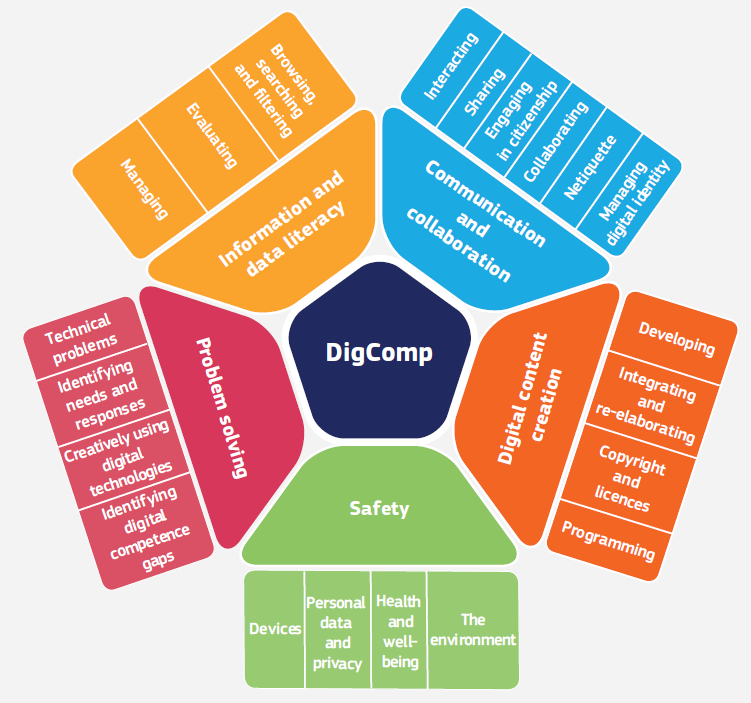
DigComp diagram showing the five areas and the 21 competences. This diagram was published in the 2020 "DigComp at Work" document, Page 7. DigComp diagram showing the five areas and the 21 competences. This diagram was published in the 2020 "DigComp at Work" document, Page 7. (Document available in our Library section.)


Live Reports on the implementation of DigComp in Adult Education Organisations

  1. Collection of Good Practice
  2. Workshop concepts
  3. What is DigComp?
  4. Project Consortium

Seite 1 von 2

  • 1
  • 2

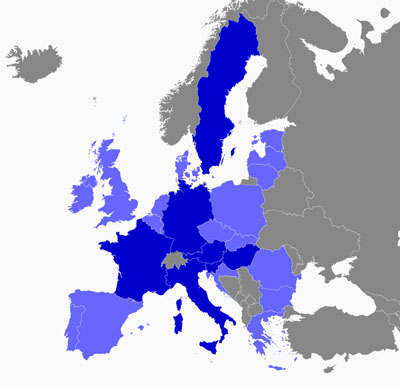
Map of Europe, the EU and the countries participating in this project

Live reporting

First draft with text fields and grayed out areas. In this example, the competence levels Safety, Communication and collaboration and Information and data literacy are addressed in the course. After successful participation, participants have attained competency level three.
November 10, 2025 213

Development of an icon for course classification

November 2025 In order to visualize the course classification of lecturers and program area managers in DigComb 2.3 AT, we began developing icons in the fall of 2025 and finally found a current draft.
November 03, 2025 490

What Employers in Sweden Expect Today: The New Digital Competence Gap

Sweden’s labour market is changing faster than at any point in recent decades. Automation, artificial intelligence, and digital workflows are no longer future trends they are already shaping how work is organised, evaluated, and performed. For Swedish employers, digital…
Voreingestelltes Bild
Oktober 17, 2025 290

A word about "digital" versus "analogue"

October 2025 There is a problem with terminology. DigComp is meant to help define "digital" skills of citizens, as a step towards helping citizens to improve these skills. But what are "digital" skills? And how are they different from "analogue skills"?
Voreingestelltes Bild
Oktober 12, 2025 254

Use a label "100 % digital-free course" as a positive selling argument?

October 2025 Did we focus too much on digital skills, and did we forget people who do not want to bothered with this at all? Here some thoughts on this.
Voreingestelltes Bild
Oktober 10, 2025 280

Observations about the popularity of DigComp in adult education

October 2025 Two workshops at our national conference on digital skills in adult education highlighted doubts about DigComp we already had.
More than 80 participants attended the conference. After a keynote by Olga Kühl the audience split into a variety of workshops.
Oktober 09, 2025 324

National conference on digital skills in adult education

A nation-wide adult education conference on the topic of digitalisation in adult education was held as part of the DigCompAE project on Wednesday, 1st of October 2025, in Hannover.
Oktober 07, 2025 249

Seniors in a Cashless Society: Why Older Adults Need Digital Confidence

In today’s Sweden, the simple act of paying for a coffee or buying groceries has become a digital experience. Cards replace cash, Swish replaces coins, and apps guide everything from travel to communication. For many people this transition feels natural—even liberating. But for…
01 Variante 1 Basis
Oktober 02, 2025 258

Presentation of competence areas – Area zero will be placed in the middle

October 2025 As part of the national conference on digital skills in Hannover (you can find a article here), we offered a workshop together with our project partners from Austria.
  • Imprint
  • Data protection

logosbeneficaireserasmusright en 0