A BarCamp event will be held in Hannover, Germany, on 24 June 2026, to open the floor for in-depth discussions of adult education experts and practitioners about the implications of digitalisation for society in general and for educational institutions in particular. The event…
Collection of Good Practice
DigComp was published first in 2013. Most adult educators in most European countries have at least heard of the competence framework. But is DigComp really in use in adult education? And if yes: how? In order to get a better picture about this, we conducted some research in the 7 participating countries and collected examples of use of DigComp for managing adult education. The results, with 3 examples of good practice from each country, are to be published as a booklet. Expect publication here shortly.
Workshop concepts
One core part of the DigCompAE project is developing workshop concepts for adult education staff to get familiar with DigComp, both it's theoretical background, and ways to apply it in adult education organisations.
In the period from July 2024 to February 2025, the seven partner organisations in the project created workshop concepts tailored to their specific needs (in terms of size of organisation, company culture, specifics of the educational system, etc.) but should also be applicabe and of use for other adult educators in the country and across Europe.
The workshop concepts consist of
a curriculum - instructions for a workshop facilitator who wants to implement a workshop (teacher training, staff training) on DigComp in their adult education organisation.
a tool kit - accompanying materials needed for workshop implementation such as presentation slides, handouts, posters, materials for group activities, readers, etc.
These wholesome workshop concepts will be made available to the public here on this website. The idea is that everybody who wants can use the workshop concepts (and tool kits) for their own inhouse staff training on DigComp, the European framework for digital competences of citizens.
The workshop concepts are all tested in (typically multiple) staff trainings in the organisations who developed them.
Currently (July 2025) the workshop concepts are in the late stage of editing and peer reviewing.Expect publication shortly (late summer 2025).
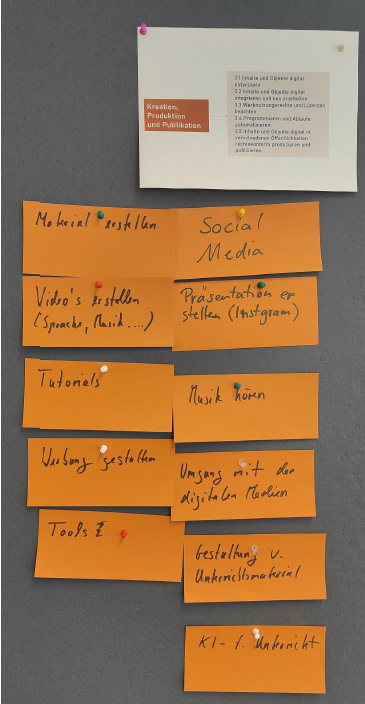
One of the paper walls created during the staff training at VHS Hannover on 29 April 2025. The task was to find everyday application of certain "digital skills" as defined in DigComp.
What is DigComp?
DigComp (current version: 2.2) is the European framework to define competencies in the area of dealing with computers (or short: digital competences) of citizens. The framework is used for different purposes. One is measuring and documenting a person's digital skills*, and doing so in a way standardized across the EU; this can be used for digital skills achieved in formal education (e.g. at school), but also in any other formal, non-formal or informal settings.
DigComp has been issued by the European Commission starting with DigComp 1.0 in 2013. It was developed by a group of experts on behalf of the Commission. It has since then been updated in several steps. In 2025, the most recent version so far is DigiComp 2.2, issued in 2022 (see our Library) A major update was integrating skills to deal with articifical intelligence (AI). A new version is in the making, and it will probably called DigComp 3.0.
DigComp relates to the European Qualification Framework (EQF) which uses a similar approach for education in general.
A similar system that is better known in the wider public is the Common European Reference Framework for Languages (CEFR) with its classification of language skills between Level A1 (beginner) and Level C2 (approximating a well-educated native speaker).
DigComp 2.2 defines five Competence Areas for dealing with the digital world:
Data literacy
Communication
Content creation
Safety
Problem solving
Each area holds three to six (sub-) competences.
For example, (sub-) competence 2.1 is: "Interacting through digital technologies".
How skillful one is with these can be measured through eight Proficiency Levels, with Level 1 for mere beginner to Level 8 for highly trained expert.
The full official document to present DigComp 2.2 is available from the EU, or you download a copy from our Library.
A short video to explain DigComp
The video was produced as part of the dissemination activities of the DigCompAE project.
* We use here "compentences" and "skills" as synonyms, for the ease of reading. However, in expert academic discourse, skills and competences are seen as different things. One well-established differentiation is seeing competences as including a) knowledge b) skills c) attitudes.
Project Consortium
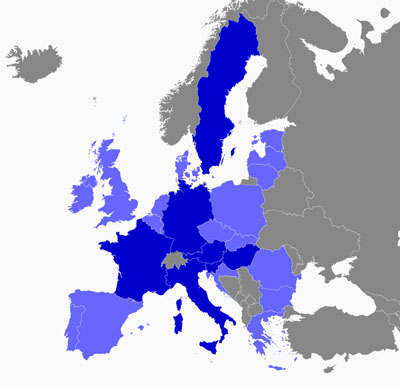
Organisations participating in the DigCompAE project are:
November 2025 In order to visualize the course classification of lecturers and program area managers in DigComb 2.3 AT, we began developing icons in the fall of 2025 and finally found a current draft.
Sweden’s labour market is changing faster than at any point in recent decades. Automation, artificial intelligence, and digital workflows are no longer future trends they are already shaping how work is organised, evaluated, and performed. For Swedish employers, digital…
October 2025 There is a problem with terminology. DigComp is meant to help define "digital" skills of citizens, as a step towards helping citizens to improve these skills. But what are "digital" skills? And how are they different from "analogue skills"?
October 2025 Did we focus too much on digital skills, and did we forget people who do not want to bothered with this at all? Here some thoughts on this.
A nation-wide adult education conference on the topic of digitalisation in adult education was held as part of the DigCompAE project on Wednesday, 1st of October 2025, in Hannover.
In today’s Sweden, the simple act of paying for a coffee or buying groceries has become a digital experience. Cards replace cash, Swish replaces coins, and apps guide everything from travel to communication. For many people this transition feels natural—even liberating. But for…
October 2025 As part of the national conference on digital skills in Hannover (you can find a article here), we offered a workshop together with our project partners from Austria.